sedation dentist near me

Orthodontic Treatment for Airway Health in
Sandy Springs & Cumming, GA

Straight Teeth Are Only One Part of the Orthodontic Picture

Orthodontic treatment is often judged by what can be seen in the mirror: Are the teeth straight? Does the smile look even? Does the bite appear better?

Those things matter. But sometimes the more important question is whether the teeth have enough room within the jaws that support them.

A child may have crowded teeth, a crossbite, a narrow palate, chronic mouth breathing, or a tongue that seems to sit low because there is limited room above it. An adult may have worn retainers faithfully and still watch their teeth crowd again. Someone who already had braces or Invisalign may have a straight-looking smile but continue to feel that the upper arch is narrow or the tongue does not fit comfortably.

Some of these patients also snore, grind their teeth, breathe through their mouth, or have concerns about sleep. Others have no airway symptoms at all.

The important point is that orthodontic findings and airway symptoms should not automatically be treated as the same problem.

At Pinewood Dentistry and Implants, orthodontic treatment for airway health in Sandy Springs & Cumming, GA, begins by determining what actually needs to change. Is the problem mainly tooth position? Is the upper jaw genuinely too narrow? Is the patient still growing? Is there enough bone to move the teeth where we want them? Are breathing or sleep symptoms present, and have they been properly evaluated? Does another provider need to be involved?

Only after those questions are answered does it make sense to choose an appliance.
When considering orthodontic treatment for airway health near you, understanding this distinction matters. Orthodontics can address certain dental and skeletal contributors that may affect oral space, jaw relationships, and breathing. It cannot diagnose obstructive sleep apnea from the appearance of the teeth, resolve every sleep concern, or correct nasal obstruction simply by straightening the smile.

The goal is to change the structure that actually needs changing—and to know when orthodontics is only one part of a larger plan.

What Does “Orthodontic Treatment for Airway Health” Actually Mean?

Airway-focused orthodontic treatment considers tooth position and bite together with the size, shape, and relationship of the jaws.

Traditional orthodontic goals still apply. We want teeth that fit together properly, positions that respect the supporting bone and gums, a functional bite, and a result that can remain stable over time.

The airway-focused part is the willingness to ask additional questions before moving the teeth.

Is the maxilla—the upper jaw—wide enough?

Is crowding primarily a dental problem or evidence of inadequate skeletal space?

How much room does the tongue have within the dental arches?

Does the lower jaw sit in a relationship that deserves closer evaluation?

Is there a crossbite?

Has previous orthodontic treatment relapsed?

Does the patient chronically breathe through the mouth?

Are snoring, grinding, poor sleep, or other symptoms present?

These findings can influence treatment planning, but none of them independently diagnoses an airway disorder.

Orthodontic and Growth Treatment in Children

Children still have developing jaws, erupting teeth, changing facial proportions, and skeletal growth ahead of them.
That creates opportunities that do not exist in exactly the same way later in life.
Pinewood offers a Complimentary Pediatric Airway & Growth Consultation for children ages 3–14 when parents notice concerns such as chronic mouth breathing, snoring, restless sleep, grinding, crowding, crossbite, a narrow palate, oral habits, or unusual jaw development.
The consultation does not mean a child automatically needs orthodontics.
Sometimes the best decision is to monitor development.
When a genuine orthodontic or skeletal problem is identified, earlier treatment may allow us to work with growth rather than waiting until the discrepancy becomes harder to correct.

A conventional palatal expander may be appropriate when a developing upper jaw is too narrow.

Depending on the case, expansion may help:

  • Correct a posterior crossbite
  • Create room for crowded or erupting teeth
  • Improve the relationship between the upper and lower arches
  • Reduce the need to compensate entirely through tooth movement
  • Increase transverse oral space

Because expansion also affects the floor of the nasal cavity, some children may experience changes in nasal airflow.

That possibility should not be turned into a promise that expansion treats pediatric sleep apnea.

If a child snores regularly, has witnessed breathing pauses, or has other symptoms suggestive of sleep-disordered breathing, medical evaluation may be necessary. Tonsil and adenoid enlargement, nasal obstruction, allergies, body weight, neuromuscular factors, and craniofacial anatomy can all contribute.

Orthodontic treatment should address a confirmed orthodontic or skeletal indication while being coordinated with the child’s broader medical needs.

The question is not simply, “Can we start orthodontics now?”

It is, “What problem are we trying to change now that would be harder to manage later?”

For one child, correcting a crossbite during growth may make sense.

For another, monitoring eruption and jaw development may be more appropriate.

Another child may need an ENT evaluation before an orthodontic appliance is considered.

At Pinewood, early treatment is not the goal. Appropriate timing is.

How Can Jaw Width, Tongue Space, and Breathing Be Connected?
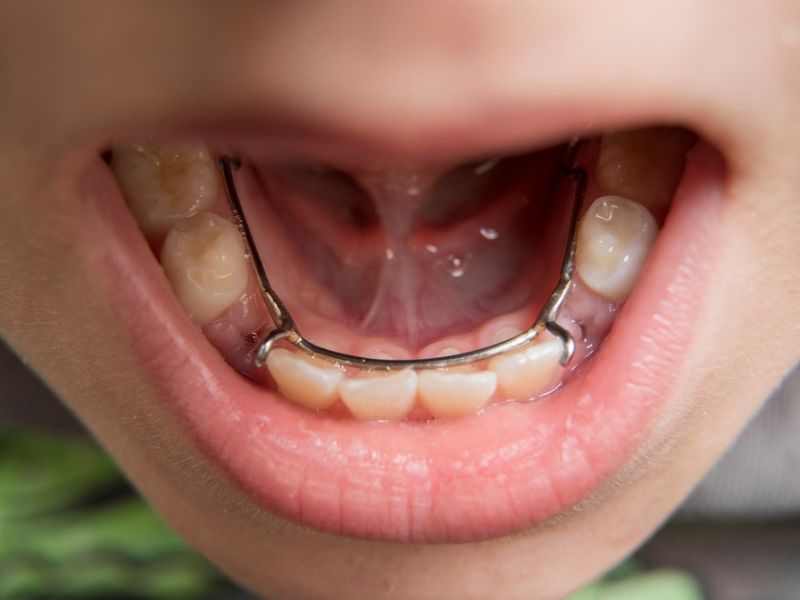
The maxilla does more than hold the upper teeth.

It forms the upper dental arch, the roof of the mouth, and part of the floor of the nasal cavity. Its width also influences how much transverse space is available inside the mouth.

When the upper jaw is significantly narrow, several findings can appear together:

  • A narrow dental arch
  • Posterior crossbite
  • Significant crowding
  • Limited room for the tongue
  • A narrow smile
  • Orthodontic relapse
  • Teeth positioned near the limits of the supporting bone

A narrow maxilla can also affect dimensions around the nasal floor. Expanding a truly narrow upper jaw may therefore increase nasal dimensions and may support improved nasal airflow in some patients.

That does not mean that expansion guarantees easier breathing.

Nasal obstruction can also result from allergies, a deviated septum, enlarged turbinates, nasal valve problems, tonsils, adenoids, inflammation, and other medical conditions. Those problems may require ENT or medical treatment.

The tongue also matters, but it should not be oversimplified.

Creating more room within the dental arches may give the tongue more space to rest. If tongue posture, swallowing, lip seal, or other oral muscle patterns remain abnormal, myofunctional therapy may sometimes be useful alongside structural treatment.

Creating space and teaching the muscles how to function within that space are different parts of care.

What Orthodontic Findings May Deserve a Closer Airway-Focused Evaluation?

Not every orthodontic problem is an airway problem. Certain combinations, however, can justify looking more deeply.

Finding What We May Need to Evaluate What It Does Not Automatically Mean
Narrow upper jaw True skeletal width, bite, tongue space, age, and supporting bone That expansion will cure a breathing problem
Posterior crossbite Whether transverse correction is needed That the patient has sleep apnea
Significant crowding Available skeletal and dental space That crowding was caused by mouth breathing
Orthodontic relapse Retention, bite, skeletal width, growth, and oral function That previous orthodontic treatment failed
Limited tongue space Arch dimensions, jaw relationships, and tongue posture That the tongue is obstructing the airway during sleep
Retruded jaw relationship Bite, facial structure, growth, and skeletal pattern That moving the teeth alone will correct the jaw
Mouth breathing or snoring Nasal, dental, skeletal, functional, and medical factors That orthodontics is the appropriate treatment

The pattern matters more than any single finding.

Moving Teeth and Changing Jaw Structure Are Not the Same Thing

This is one of the most important distinctions in airway-focused orthodontics.

Clear aligners and braces can move teeth through supporting bone. They are excellent tools when tooth position is the primary problem.

But moving teeth outward is not necessarily the same as creating meaningful skeletal width.

If an upper jaw is genuinely too narrow, simply tipping or moving the teeth farther toward the outside of the existing bone may not correct the underlying transverse deficiency. In some patients, that approach can also push tooth movement closer to the limits of the supporting tissues.

When skeletal width is the problem, the treatment discussion may need to include expansion.

The type of expansion depends heavily on age, skeletal maturity, anatomy, and treatment goals.

Why Orthodontic Treatment Is Different for Children and Adults

A growing child and a skeletally mature adult may have similar-looking crowding but require completely different treatment.

That difference is central to treatment planning at Pinewood.

Orthodontic Treatment in Adults

Adults can still move teeth successfully. What changes is the skeletal part of the equation.

Once the upper jaw has matured, a conventional tooth-supported expander may not create the same skeletal response expected in a growing child.

That is why adult treatment needs a clear distinction between dental expansion and skeletal expansion.

Clear Aligners Can Move Teeth—But They Do Not Replace Skeletal Expansion

Invisalign and other clear aligner systems can align teeth, coordinate the bite, correct certain arch-form problems, and produce controlled dental expansion.

They are valuable orthodontic tools.

But if an adult has a meaningful transverse deficiency of the upper jaw, aligners alone cannot simply make the mature skeletal foundation wide enough.

Trying to solve a skeletal problem only by moving teeth can sometimes create compromises in tooth position, gum support, or long-term stability.

The correct approach depends on how much of the problem is dental and how much is skeletal.

MARPE for Selected Adults and Older Teens

When true maxillary transverse deficiency is present, Pinewood may consider Miniscrew-Assisted Rapid Palatal Expansion, or MARPE.

MARPE uses temporary anchorage devices, or TADs, in the palate so expansion forces are directed more toward the maxillary skeleton rather than relying primarily on the teeth.

Dr. Lincoln Fantaski has a particular clinical focus on adult airway dentistry and MARPE adult expansion.

At Pinewood, MARPE is not treated as an isolated expansion procedure. It is typically coordinated with Invisalign or comprehensive orthodontic treatment because widening the upper jaw creates new skeletal space, but the teeth and bite still need to be guided into that space.

Pinewood’s TAD-first guided MARPE protocol establishes skeletal anchorage first and coordinates expansion with clear-aligner treatment. This gives the team greater control over the teeth and bite as the maxilla widens and helps avoid the large front-tooth gap commonly associated with traditional MARPE protocols.

MARPE is not appropriate for every adult.

Skeletal maturity, palatal anatomy, bone quality, periodontal support, severity of the transverse deficiency, previous treatment, and broader jaw relationships all affect candidacy.
In patients with particularly dense or resistant bone, additional surgical assistance may sometimes be needed.

Where Does Jaw Surgery Fit?

Not every skeletal problem can be solved with orthodontic tooth movement or transverse expansion.

MARPE primarily addresses width.

It does not correct every significant front-to-back discrepancy between the upper and lower jaws.

An adult with substantial skeletal retrusion, severe malocclusion, or diagnosed OSA related partly to craniofacial structure may need an oral and maxillofacial surgical evaluation.

Procedures such as maxillomandibular advancement or other orthognathic surgery can change jaw position in ways orthodontics alone cannot.

For patients who have both transverse and front-to-back skeletal discrepancies, treatment sequencing matters.

Pinewood’s MARPE philosophy includes evaluating upper-jaw width before a major jaw-surgery plan is finalized because a transverse deficiency may need to be addressed separately or earlier.

The point is not that every complex airway patient needs surgery.

It is that we should not ask aligners to perform skeletal expansion, or ask expansion to correct a jaw relationship that requires another treatment.

How Pinewood Plans Orthodontic Treatment When Airway Health Is Part of the Conversation

There is no single “airway orthodontic appliance” that works for everyone.

Treatment begins with diagnosis and records.

Step 1: Understanding the Problem You Are Trying to Solve

We begin with your dental and orthodontic concerns.

Are the teeth crowded?

Has previous treatment relapsed?

Is there a crossbite?

Does the upper arch feel narrow?

Is the tongue crowded?

Are you concerned about mouth breathing, snoring, grinding, or sleep?

For children, we also consider growth, eruption, oral habits, and what parents observe during sleep.

If airway or sleep symptoms are part of the story, we ask what has already been evaluated medically.

Step 2: Examining the Teeth, Bite, Jaws, and Supporting Tissues

The examination helps us separate tooth-position problems from skeletal ones.

We evaluate factors such as:

  • Arch width
  • Crowding and spacing
  • Crossbite
  • Overbite and overjet
  • Upper- and lower-jaw relationships
  • Tongue space
  • Palate shape
  • Tooth wear
  • Gum recession
  • Periodontal support
  • Previous orthodontic movement and relapse

Two patients can have similar crowding and require very different treatment because the bone, jaw width, and bite underneath the teeth are different.

Step 3: Building Detailed Digital Records

Pinewood uses photographs, digital intraoral scans, X-rays, and 3D imaging when appropriate.

Digital scans allow us to study the bite and dental arches accurately.

Three-dimensional imaging can become especially important for complex expansion because it allows us to assess skeletal relationships, tooth roots, available bone, and the anatomy relevant to MARPE planning.

Imaging can also show airway anatomy, but an image taken while someone is awake does not diagnose a sleep disorder or tell us how the airway behaves throughout the night.

If sleep-disordered breathing is suspected, objective sleep testing and medical involvement may still be needed.

Step 4: Determining Whether the Problem Is Dental, Skeletal, Functional, or a Combination

This is the decision point that shapes the rest of treatment.

A primarily dental problem may be handled with clear aligners or another orthodontic approach.

A growing child with skeletal narrowing may benefit from conventional expansion.

An adult with true transverse maxillary deficiency may need MARPE.

A patient with significant nasal obstruction may need an ENT.

A patient whose tongue posture or swallowing pattern is contributing to oral function may benefit from myofunctional therapy.

A major skeletal jaw discrepancy may justify surgical evaluation.

Sometimes more than one of these is true.

Step 5: Coordinating Expansion and Tooth Movement

When expansion is part of the plan, treatment does not stop once more width has been created.

The teeth need to be positioned appropriately within the changed arch, and the upper and lower bites need to be coordinated.

For adults undergoing MARPE at Pinewood, Invisalign is typically integrated into the overall treatment rather than being treated as an unrelated phase.

This allows skeletal change and orthodontic tooth movement to be planned together.

For children, the timing of braces or aligners after expansion depends on age, eruption, growth, and the individual orthodontic problem.

Step 6: Monitoring the Teeth, Bone, Bite, and Response

Orthodontic treatment is adjusted over time.

We monitor whether teeth are moving as planned, whether expansion is occurring where intended, how the bite is developing, how the gums and supporting tissues are responding, and whether the patient is adapting comfortably.

If treatment is being coordinated with airway or sleep care, symptom changes may be worth documenting, but symptoms alone do not prove that a diagnosed sleep disorder has resolved.

When objective follow-up sleep testing is appropriate, it should remain part of the medical-airway pathway.

Step 7: Retention and Long-Term Stability

Creating a result is only part of orthodontics. Keeping it stable matters too.

Retention allows the teeth and supporting tissues to adapt after movement.

Following expansion, additional time may also be needed for skeletal and dental stabilization.

Long-term stability depends on several factors, including the original problem, treatment mechanics, retainer use, periodontal health, continued growth or aging, bite relationships, and oral function.

The goal is not simply a straight photograph on the day treatment ends. It is a result built on a foundation that makes sense for the patient.

What Can Airway-Focused Orthodontic Treatment Realistically Accomplish?

Good treatment planning requires being clear about both possibilities and limitations.

When appropriately indicated, orthodontic and skeletal treatment may:

  • Correct crowding and malocclusion
  • Improve crossbites
  • Create appropriate dental or skeletal width
  • Provide more room for tooth alignment
  • Improve the relationship between the upper and lower arches
  • Create additional oral space for the tongue in selected patients
  • Help position teeth more appropriately within the supporting tissues
  • Address structural factors that may be relevant to breathing in selected patients
  • Improve orthodontic stability when inadequate width was part of the original problem

It should not be promised to:

  • Cure obstructive sleep apnea
  • Eliminate snoring in every patient
  • Correct allergies or nasal inflammation
  • Remove enlarged tonsils or adenoids
  • Fix a deviated septum
  • Replace CPAP when CPAP remains medically necessary
  • Correct every skeletal jaw problem through tooth movement
  • Guarantee better sleep simply because the dental arches become wider

This is where comprehensive care matters.

Orthodontics is most useful when we are asking it to solve an orthodontic or skeletal problem it is actually capable of changing.

What Makes Pinewood’s Approach Different?

At Pinewood Dentistry and Implants, orthodontic treatment is not separated from bite function, periodontal support, jaw structure, airway concerns, or the patient’s previous dental history.

Dr. Fantaski’s work with adult airway patients and MARPE allows complex skeletal-width problems to be evaluated alongside orthodontic treatment rather than treating expansion as an isolated procedure.

Dr. Katie Fadler and Dr. Urvi Ruparelia work with clear aligners and airway-focused patients and also evaluate pediatric airway and growth concerns. Pinewood’s broader team is trained to recognize airway-related findings and help patients determine when orthodontics, sleep testing, ENT care, myofunctional therapy, or another discipline should be involved.

The practice also uses digital photography, intraoral scanning, X-rays, and 3D imaging to plan treatment and show patients what is happening rather than asking them to accept a recommendation without understanding the reason behind it.

That fits Pinewood’s larger philosophy: look carefully, explain clearly, and treat the underlying problem rather than simply moving the visible teeth.

Which Consultation Is the Right Starting Point?

Adults who have a narrow upper arch, significant crowding, orthodontic relapse, limited tongue space, mouth breathing, snoring, or questions about skeletal expansion can begin with Pinewood’s Complimentary Adult Airway & MARPE Consultation.

You do not need a previous sleep-apnea diagnosis or a referral to start the conversation.

Children ages 3–14 with crowding, crossbite, a narrow palate, mouth breathing, snoring, restless sleep, grinding, oral habits, or concerns about jaw development can begin with a

Complimentary Pediatric Airway & Growth Consultation.

An evaluation does not commit you or your child to treatment.

It allows us to determine whether the problem belongs primarily to tooth alignment, skeletal growth or width, sleep medicine, ENT care, oral function—or some combination.

When considering orthodontic treatment for airway health near you, that is the information you need before deciding on braces, aligners, an expander, MARPE, or any other appliance.

The goal is not to make every airway concern orthodontic.

It is to recognize when orthodontic treatment can meaningfully improve the structure and function we are responsible for—and when another type of care belongs in the plan.

Schedule an adult or pediatric airway consultation at Pinewood Dentistry and Implants in Cumming or Sandy Springs to find out what the teeth, bite, jaws, and available records are actually telling us.

Have Questions About Orthodontic Treatment for Airway Health? Start Here.

No. Orthodontics should not be presented as a universal cure for obstructive sleep apnea. OSA is a medical sleep disorder with multiple possible contributors, including soft tissues, nasal obstruction, body weight, sleep physiology, muscle tone, and craniofacial anatomy. Orthodontic or skeletal treatment may address a relevant structural factor in selected patients, but suspected or diagnosed OSA should be appropriately evaluated and managed with the medical team.

No. Mouth breathing can occur because of nasal obstruction, allergies, enlarged tonsils or adenoids, habit, oral posture, craniofacial anatomy, or a combination of factors. Expansion is appropriate when a complete orthodontic evaluation identifies a genuine transverse or bite problem that warrants treatment. A child with persistent mouth breathing or snoring may also need medical or ENT evaluation.

Clear aligners can create certain types of dental expansion by changing tooth position and arch form. That is different from meaningful skeletal expansion of a mature maxilla. If an adult has a true transverse skeletal deficiency, Pinewood may evaluate whether MARPE or another approach is more appropriate rather than trying to solve the entire discrepancy through tooth movement alone.

MARPE creates skeletal width, but the teeth and bite still need to be guided into the new space. Pinewood coordinates MARPE with Invisalign so expansion and tooth movement can be planned together. In Pinewood’s TAD-first guided protocol, this coordination also helps maintain better control of the front teeth and avoids the dramatic front-tooth gap commonly associated with traditional MARPE treatment.

Because the roof of the mouth is also the floor of the nasal cavity, skeletal expansion can increase nasal dimensions. Some appropriately selected patients report easier nasal breathing after expansion. Results vary, however, and expansion cannot correct every cause of nasal obstruction. Allergies, septal deviation, enlarged turbinates, tonsils, adenoids, and other conditions may require separate medical treatment.

Straight teeth do not necessarily mean that the skeletal foundation has ideal width. Some patients had previous orthodontics that aligned the teeth within a narrow arch without correcting a significant transverse skeletal deficiency. If symptoms, relapse, bite findings, tongue-space concerns, or other clinical signs suggest that width remains an issue, Pinewood can evaluate the underlying jaw structure and determine whether any further treatment is actually indicated.