sedation dentist near me

Airway Evaluations & Screening in
Sandy Springs & Cumming, GA

Sometimes the Clues Are in Different Places

A patient may come to Pinewood because of snoring. Another comes because their teeth have shifted after orthodontic treatment. Someone else is concerned that their child sleeps with an open mouth, grinds at night, or has developed a narrow, crowded smile.

Then there is the patient who simply says, “I sleep all night, but I never feel rested.”

None of these concerns automatically means there is an airway disorder.
Snoring can have several causes. Grinding does not prove that breathing is restricted. Crowded teeth do not diagnose sleep apnea. Fatigue can come from dozens of medical, sleep, and lifestyle factors.

But when several of these findings appear together, it can be useful to stop treating them as unrelated problems.

The teeth, bite, tongue, palate, upper and lower jaws, nasal breathing, sleep patterns, and oral function all exist within the same anatomical system. An airway-focused evaluation gives us a chance to look at that system as a whole and decide whether the patterns we see deserve further investigation.

At Pinewood Dentistry and Implants, we provide airway evaluations & screening in Sandy Springs & Cumming, GA, for adults and children with concerns involving breathing, sleep, jaw development, oral function, or related dental findings. Our goal is not to label every symptom as an airway problem or start treatment before we understand what is happening.

It is to connect the clues.

When researching airway evaluations & screening near you, the most important distinction is that screening is a starting point—not a diagnosis and not a treatment. It helps us determine what appears healthy, what deserves a closer look, what additional information may be needed, and which provider or treatment pathway makes sense from there.

What Is an Airway Evaluation?

An airway evaluation is an assessment of the dental, skeletal, functional, and symptom patterns that may relate to breathing and sleep.
Dentists have a unique view of several structures involved in this system. We see the width and shape of the palate, the amount of space available for the tongue, the relationship between the upper and lower jaws, how the teeth fit together, signs of grinding and wear, gum recession, orthodontic relapse, and patterns of oral posture.
We can also ask questions that may not normally come up during a routine dental examination:
Are you breathing through your mouth at night?
Do you snore?
Do you wake with a dry mouth or headache?
Does your child sleep restlessly or grind their teeth?
Did your teeth become crowded again after braces?
Does your tongue feel as though it has enough room?
Has anyone witnessed pauses or gasping while you sleep?
Do you wake feeling rested?
Those questions can identify patterns that deserve more attention.
They cannot tell us, by themselves, whether someone has obstructive sleep apnea, UARS, nasal obstruction, or another sleep disorder.
That difference matters.

What Can the Mouth Tell Us About Breathing and Sleep?

The mouth cannot tell us everything, but it can reveal structural and functional clues that are difficult to see elsewhere.

The maxilla, or upper jaw, forms the upper dental arch, supports the upper teeth, creates the roof of the mouth, and contributes to the floor of the nasal cavity.

When the maxilla is relatively narrow, patients may also have a narrow dental arch, crossbite, crowding, limited tongue space, or a narrow smile.

That does not prove a breathing disorder.

It does tell us that transverse jaw development may deserve evaluation, particularly when those findings occur alongside chronic mouth breathing, snoring, orthodontic relapse, or other sleep-related symptoms.

The tongue is a large muscular structure that needs adequate room within the dental arches.

A narrow upper arch, retruded jaw relationship, or limited oral volume can affect how much room the tongue has at rest.

We consider where the tongue appears to rest, how much space is available, whether the patient habitually breathes through the mouth, and whether oral posture may be part of a broader functional pattern.

Tongue position alone does not diagnose airway obstruction. It is one piece of anatomy that can become more meaningful when considered alongside everything else.

The relationship between the upper and lower jaws can influence the bite, facial structure, tongue position, and the amount of space around portions of the upper airway.

A lower jaw that sits relatively far back may deserve particular attention in a patient who also snores or has diagnosed sleep-disordered breathing.

In growing children, jaw relationships are evaluated differently because development is still occurring. In adults, significant skeletal discrepancies may require orthodontic, expansion, or surgical discussions that are very different from growth-oriented treatment.

We also look at what has happened to the teeth over time.

Heavy wear, fractured restorations, recession, muscle soreness, or evidence of grinding can provide information about nighttime loading and bite function.

Bruxism has many possible causes, so it should never automatically be blamed on an airway problem.

But grinding combined with poor sleep, snoring, mouth breathing, limited tongue space, or a narrow jaw may justify asking more questions.

When teeth become crowded again after braces or clear aligners, the reason may be as simple as retainer use or normal changes over time.

In other patients, relapse raises a different question: was there enough room within the underlying skeletal foundation in the first place?

That does not mean every patient with relapse needs expansion. It means that repeating orthodontic treatment without reassessing arch width, bite, bone support, tongue space, and oral function may miss information that affects long-term stability.

Screening Answers One Question: Should We Look Further?
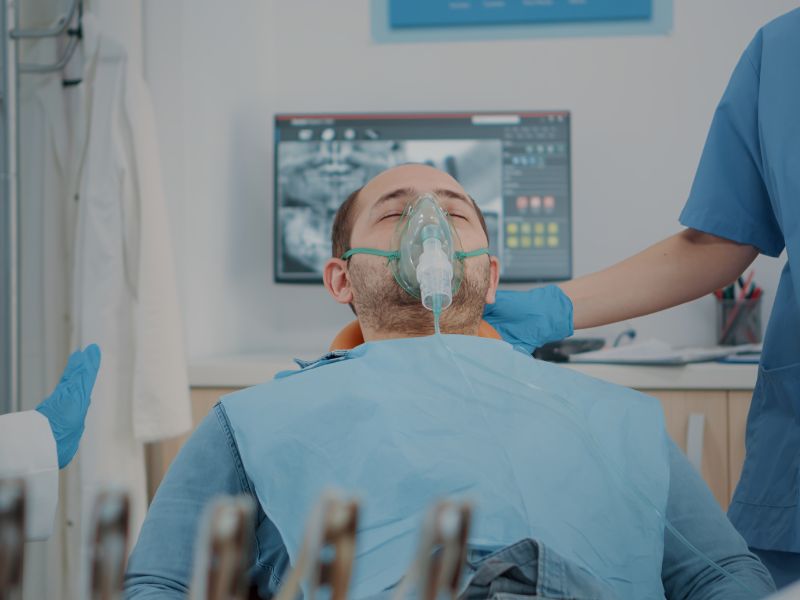
An airway screening is essentially a risk-identification process.

It asks whether the symptoms, anatomy, dental findings, and history suggest that breathing or sleep should be investigated more closely.

Sometimes the answer is no.

Sometimes the findings suggest that a sleep study would be appropriate.

Other patients may need an ENT evaluation, orthodontic records, a pediatric growth assessment, myofunctional evaluation, or another type of medical care.

The value of screening is not that it gives every patient an airway diagnosis. The value is that it helps us decide which questions still need answers.

What Findings Can Prompt a Closer Airway Evaluation?

No single dental or sleep finding confirms an airway disorder. What matters is the pattern.

Finding Why We May Look More Closely What It Does Not Prove
Snoring May indicate turbulent airflow through a narrowed upper airway That OSA is present
Mouth breathing May suggest nasal resistance, habit, oral posture concerns, or another breathing issue That the jaws caused the problem
Narrow palate or crossbite May indicate transverse maxillary deficiency That expansion will improve sleep
Limited tongue space May reflect restricted oral volume or jaw relationships That the tongue is obstructing the airway during sleep
Grinding and tooth wear May occur alongside sleep-related breathing disorders That bruxism is caused by an airway problem
Orthodontic relapse May justify reassessing skeletal space, bite, and oral function That the previous orthodontics was inappropriate
Daytime fatigue Can occur with disrupted or inadequate sleep That sleep apnea or UARS is the cause
Gasping or witnessed pauses Raises concern for a sleep-related breathing disorder The diagnosis or severity of that disorder

The purpose of an airway evaluation is to understand which of these observations belong together and which may be unrelated.

Signs Adults May Want to Discuss With Us

Adults often come to Pinewood after living with a pattern for years without realizing the pieces may be connected.
Reasons to consider an airway-focused evaluation may include:

  • Loud or regular snoring
  • Witnessed pauses, gasping, or choking during sleep
  • Chronic mouth breathing
  • Waking with a dry mouth
  • Morning headaches
  • Feeling unrefreshed despite enough time in bed
  • Daytime fatigue or brain fog
  • Grinding or clenching
  • TMJ or facial-muscle symptoms
  • Heavy tooth wear or repeated dental fractures
  • Limited tongue space
  • A narrow upper arch
  • Crossbite or significant crowding
  • Orthodontic relapse
  • Difficulty tolerating CPAP

Questions about MARPE or adult skeletal expansion

Some of these findings may eventually lead to dental treatment. Others may lead us away from dentistry and toward a sleep physician, ENT, or another healthcare provider.
Both are useful outcomes.

Airway Screening Looks Different in Children

Children should not simply be treated like smaller adults.

Their jaws, facial structures, teeth, oral habits, and breathing patterns are developing at the same time.

Parents may notice:

  • Chronic mouth breathing
  • Snoring
  • Restless sleep
  • Nighttime grinding
  • Difficulty waking
  • Unusual sleeping positions
  • Crowded teeth
  • Crossbite
  • A narrow palate
  • Persistent oral habits
  • Concerns about facial or jaw growth
  • Bedwetting beyond the expected developmental stage
  • Attention or behavioral concerns occurring alongside poor sleep

None of these findings independently diagnoses pediatric obstructive sleep apnea.

Tonsil and adenoid size, nasal obstruction, allergies, body weight, craniofacial development, and other medical factors may also contribute to sleep-related breathing problems in children.

When we identify concerning symptoms or findings, medical referral may be appropriate.

At Pinewood, the pediatric airway evaluation is therefore about growth, structure, function, and risk—not about putting every child into an appliance.

For children ages 3–14, Pinewood offers a Complimentary Pediatric Airway & Growth Consultation focused on breathing, sleep, oral habits, crowding, bite development, palatal width, and jaw growth.

Sometimes treatment is appropriate.

Sometimes monitoring is better.

Sometimes the next appointment should be with an ENT, pediatrician, or sleep specialist rather than with us.

The evaluation helps clarify that decision.

What Happens During an Airway Evaluation at Pinewood?

A true airway consultation is more detailed than simply asking whether you snore.

Step 1: Understanding Why You Came In

We start with the symptoms or concerns that brought you to Pinewood.

For an adult, that might be fatigue, snoring, mouth breathing, clenching, orthodontic relapse, poor CPAP tolerance, limited tongue space, or curiosity about MARPE.

For a child, parents may be concerned about mouth breathing, restless sleep, grinding, crowding, a crossbite, oral habits, or jaw development.

We want to know what you notice, what a partner or parent has observed, how long the problem has been present, and what has already been investigated.

Step 2: Reviewing Medical, Sleep, Dental, and Orthodontic History

Previous information can change what we need to evaluate.

We may review:

  • Previous sleep studies
  • OSA or other sleep diagnoses
  • CPAP or oral appliance experience
  • ENT evaluations
  • Tonsil or adenoid treatment
  • Nasal surgery
  • Allergies or chronic congestion
  • Previous orthodontics
  • Palatal expansion
  • Tooth extractions
  • Retainer history
  • Jaw surgery
  • Myofunctional therapy
  • Relevant medications and health conditions

A patient who already has diagnosed OSA needs a different conversation from someone who has never undergone sleep testing.

Step 3: Examining the Teeth, Bite, Palate, and Jaw Relationships

We examine the structures dentistry can evaluate directly.

That may include arch width, crowding, crossbite, tooth position, wear patterns, periodontal health, tongue space, palate shape, upper- and lower-jaw relationships, and TMJ or muscle findings.

We also consider whether the teeth appear to be positioned comfortably within the supporting bone or whether previous orthodontic treatment has relapsed.

The aim is not to find as many abnormalities as possible.

It is to determine which findings are clinically meaningful.

Step 4: Looking at Oral Function and Breathing Patterns

We may discuss nasal versus mouth breathing, resting oral posture, lip seal, tongue posture, swallowing patterns, and related habits.

When oral muscle function appears important, myofunctional therapy may eventually become part of the discussion.

A functional observation is still not a sleep diagnosis. It simply gives us another piece of information about how the oral system is working.

Step 5: Building the Digital Record

Pinewood may use photographs, digital intraoral scans, X-rays, and 3D imaging when those records add useful information.

Digital scans allow us to study the bite and arch relationships in detail.

X-rays can help evaluate teeth, roots, supporting structures, and skeletal relationships.

Three-dimensional imaging may be particularly useful when we are assessing maxillary width, skeletal anatomy, available bone, MARPE candidacy, or another complex orthodontic or surgical question.

There is an important limitation here: an airway can look narrow or open on an image without telling us exactly what happens while the patient is asleep.

CBCT and other images show anatomy at one point in time. They do not diagnose OSA, UARS, or the physiologic severity of sleep-disordered breathing.

That requires different information.

Step 6: Deciding Whether Objective Sleep Information Is Needed

Some patients arrive with an established sleep diagnosis. Others have never been tested.

If symptoms raise concern for obstructive sleep apnea or another sleep-related breathing disorder, Pinewood may recommend appropriate sleep evaluation rather than trying to diagnose the condition from the dental examination.

For selected adults, that may involve a physician-interpreted home sleep apnea test.

Other patients may need an in-lab polysomnogram, particularly when the clinical situation is more complex, a home study has not explained persistent symptoms, or another type of sleep disorder is suspected.

Children with suspected OSA require appropriate pediatric medical evaluation rather than simply following an adult home-testing pathway.

Step 7: Connecting the Findings Before Recommending Treatment

This is where the evaluation becomes useful.

We ask:

Is there actually a dental or skeletal problem to treat?

Does the patient need a sleep diagnosis first?

Is nasal obstruction likely important?

Would oral appliance therapy make sense?

Is the upper jaw genuinely narrow?

Is the patient still growing?

Would expansion address a structural deficiency?

Does tongue function need attention?

Should an ENT, sleep physician, myofunctional therapist, orthodontic provider, or surgeon be involved?

The answer may be one treatment, several coordinated treatments, or no immediate treatment at all.

Screening, Diagnosis, and Treatment Are Three Different Things

These terms should not be used interchangeably.

Screening
Screening identifies signs, symptoms, anatomy, or history that may increase suspicion for an airway or sleep-related breathing concern.

Diagnosis
Diagnosis determines what disorder is actually present.

For conditions such as obstructive sleep apnea, medical sleep evaluation and objective testing play an essential role.

Treatment
Treatment addresses the diagnosed or clearly identified problem.

That may involve dentistry, orthodontics, sleep medicine, ENT care, myofunctional therapy, surgery, lifestyle changes, or several disciplines working together.

Keeping these three steps separate helps prevent overtreatment.

It also prevents us from dismissing a patient’s symptoms simply because the dental examination did not provide the entire answer.

What Can Happen After an Airway Evaluation?

An airway evaluation does not lead everyone to the same place.
Depending on the findings, the next step may include:

No Immediate Treatment
Not every anatomical variation needs treatment.

If the findings do not indicate an active concern, we may recommend observation or routine monitoring.

Sleep Testing or Sleep-Medicine Evaluation
Snoring, witnessed apneas, significant daytime sleepiness, gasping, or other concerning symptoms may require objective evaluation before dental treatment is considered.

ENT Evaluation
Chronic nasal obstruction, enlarged tonsils, suspected adenoid concerns, recurrent congestion, or other upper-airway issues may need medical or surgical assessment.

Oral Appliance Therapy
For appropriately diagnosed adults with obstructive sleep apnea or primary snoring, a custom mandibular advancement appliance may be considered when it fits the medical and dental treatment plan.

Pediatric Growth or Orthodontic Treatment
Growing children with true skeletal or bite problems may benefit from monitoring, palatal expansion, Myobrace or another growth-oriented approach, orthodontics, or coordinated myofunctional care depending on the diagnosis.

Clear Aligners or Comprehensive Orthodontics
Some patients primarily need dental alignment and bite correction.

Airway-focused evaluation does not mean that every orthodontic patient requires skeletal expansion.

MARPE
For selected older teens and adults with true transverse maxillary deficiency, Pinewood may consider Miniscrew-Assisted Rapid Palatal Expansion.

MARPE is designed to create skeletal width in the upper jaw. At Pinewood, adult expansion can be coordinated with Invisalign so the teeth and bite are managed as the skeletal foundation changes.

MARPE may influence nasal dimensions, tongue space, and the relationship between the dental arches, but it should not be presented as a guaranteed cure for a sleep disorder.

Myofunctional Therapy
When tongue posture, lip seal, swallowing, or oral muscle patterns appear relevant, myofunctional therapy may support the broader plan.

Surgical Evaluation
Some patients have skeletal or anatomical problems that cannot be adequately addressed with tooth movement or an oral appliance.

When that is the case, surgical consultation may be more appropriate than trying to make a less suitable dental treatment do a job it was not designed to do.

Why Pinewood Does Not Use One Airway Solution for Everyone

The airway world can become overly appliance-focused very quickly.

A snoring patient is offered a mandibular device.

A narrow-palate patient is offered expansion.

A tired patient is told they have an airway problem.

That approach skips the most important step: diagnosis.

Pinewood’s philosophy is different.

Our doctors look at how the teeth, jaws, tongue space, bite, oral function, breathing, and sleep findings may relate, while recognizing where dentistry ends and another discipline needs to begin.

Dr. Lincoln Fantaski has a particular clinical focus on adult airway dentistry, MARPE adult palatal expansion, oral surgery, and complex treatment planning.

Dr. Katie Fadler and Dr. Urvi Ruparelia work with adult airway patients and also evaluate pediatric airway and growth concerns.

Dr. Bryan Scalf and Dr. Gary Tyrone Bishop are trained in airway evaluation and can help patients identify relevant dental findings and determine what should happen next.

Because airway concerns can overlap with orthodontics, TMJ symptoms, restorative dentistry, tooth wear, jaw development, sleep medicine, and ENT care, the doctors can work together when the patient needs a broader plan.

A Screening May Take Minutes. A True Airway Consultation Goes Much Deeper.

A basic airway screening can sometimes be incorporated into a routine dental visit and may take only a few additional minutes.

A comprehensive airway consultation is different.

When we need to review symptoms in detail, examine jaw and bite relationships, take photographs or updated scans, assess previous treatment, discuss sleep findings, and work through possible next steps, the appointment may take approximately an hour to an hour and a half.

There is a reason for that time.

The purpose is not simply to tell you that your palate looks narrow.

We want you to understand what we see, what we do not yet know, what findings are actually important, and which questions still need to be answered before treatment begins.

That is much closer to the way Pinewood approaches complex dentistry in general: understand the cause before choosing the fix.

Which Pinewood Airway Consultation Is Right for You?

Complimentary Adult Airway & MARPE Consultation

Adults can begin here for concerns such as:

  • Snoring
  • Mouth breathing
  • Poor-quality sleep
  • Grinding or clenching
  • Limited tongue space
  • Narrow arches
  • Significant crowding
  • Orthodontic relapse
  • Difficulty tolerating CPAP
  • Questions about MARPE or adult expansion

You do not need a previous sleep diagnosis, sleep study, or referral to schedule the consultation.

If you already have sleep-study results, CPAP records, previous imaging, orthodontic records, or another relevant diagnosis, bringing that information can help us understand what has already been investigated.

Complimentary Pediatric Airway & Growth Consultation

Pinewood offers this consultation for children ages 3–14 with concerns such as:

  • Mouth breathing
  • Snoring
  • Restless sleep
  • Grinding
  • Crowding
  • Crossbite
  • Narrow palate
  • Oral habits
  • Tongue-space concerns
  • Jaw or facial growth questions

The consultation helps determine whether treatment, medical referral, additional records, or monitoring makes sense at the child’s current stage of growth.

Start by Understanding the Whole Picture

Airway-focused care should not begin with a promise that fixing the teeth will fix sleep.

It should begin with questions.

Why is this patient mouth breathing?

Why is the palate narrow?

Why did orthodontic treatment relapse?

Why does the tongue feel crowded?

Why is a child grinding every night?

Why does someone continue to wake exhausted even though a previous test did not seem alarming?

Sometimes those questions lead to dentistry.

Sometimes they lead to sleep medicine, ENT care, myofunctional therapy, or another specialty.

Often, the best plan comes from several providers contributing different pieces of the answer.

If you are researching airway evaluations & screening near you because you or your child has symptoms or dental findings that have never quite made sense together, Pinewood Dentistry and Implants can help you begin sorting them out.

You do not need to know which appliance you need.

You do not need to arrive with a diagnosis.

And you do not need every question answered before the first appointment.

Schedule a Complimentary Adult Airway & MARPE Consultation or Pediatric Airway &

Growth Consultation at our Cumming or Sandy Springs location. We will look carefully at the dental and structural information we can evaluate, explain what the findings do—and do not—tell us, and help determine the most appropriate next step.

Have Questions About Airway Evaluations and Screening? Start Here.

No. A dental airway evaluation can identify symptoms, risk factors, oral findings, and craniofacial features that may justify further investigation, but it does not replace objective sleep testing or a medical sleep diagnosis. If OSA is suspected, we can help determine what additional evaluation may be appropriate.

No. Pinewood’s adult and pediatric airway consultations can be the starting point even if you have never had sleep testing. If you already have a sleep study, previous imaging, CPAP history, ENT records, or orthodontic information, those records can be useful. If objective sleep testing is needed, we can discuss that as part of the next steps.

No. Three-dimensional imaging can provide valuable anatomical information about the jaws, palate, teeth, surrounding structures, and airway dimensions, but it captures anatomy while you are awake and cannot show exactly how the airway behaves throughout sleep. OSA is diagnosed using appropriate sleep evaluation rather than CBCT appearance alone.

Dentists regularly see the teeth, palate, tongue space, bite, and developing jaws, so they may notice findings that make breathing or sleep worth discussing. Snoring, chronic mouth breathing, restless sleep, and certain craniofacial findings can justify further evaluation, but they do not automatically mean a child has OSA or needs orthodontic treatment. Medical referral may also be appropriate.

No. A narrow-looking smile or dental arch does not automatically mean the patient needs skeletal expansion. We consider the patient’s age, actual skeletal width, bite, tooth position, supporting bone, tongue space, symptoms, growth stage, and treatment goals before recommending expansion. The purpose is to treat a confirmed structural problem rather than expand simply because an airway concern exists.

That is still a useful result. Airway-focused care is partly about knowing when another provider has the more appropriate treatment. Depending on what we find, we may recommend evaluation by a sleep physician, ENT, pediatrician, myofunctional therapist, oral surgeon, or another healthcare professional. The goal is not to keep every part of treatment inside Pinewood; it is to help you reach the right diagnosis and treatment pathway.